
The Wayne County Wanted List
Wayne County posts no public most-wanted gallery. There is no browsable Sheriff warrant list either. What the county publishes is a description of the work instead. The Patrol/K-9 Division page explains that the Warrant Squad serves warrants and arrest orders assigned to the Sheriff's Office. Those orders can come from all 100 North Carolina counties. Some arrive from other states. That detail matters. A Wayne inquiry can easily involve paperwork that started somewhere else entirely.
A curated wanted page and an active warrant are different animals. Public lists tend to be selective, dated, or limited to cases an agency chooses to spotlight. A missing name means nothing. Go through the Sheriff directly or the Wayne County courts instead of relying on any unverified name or photo. If the person has already been booked, the county custody guide sorts out why VINE and a records request answer different questions.
Wanted notices are public records. A name appears on the sheriff's list when a warrant has been signed for that person by a judge in Wayne County.
What a Wanted Notice Shows
Wayne County publishes no standard wanted page, so treat the fields below as a general reading guide rather than a promise of what a county listing contains. Whatever details you find, match each one to its source and its date before relying on it. A face or a name alone never settles identity. Context does that work.
| Possible field | How to read it |
|---|---|
| Name | Use the exact spelling supplied by the agency or court, and watch for common-name matches. |
| Photo | Keep it on the originating government or news page. This site does not rehost wanted or booking photos. |
| Warrant basis | Read the charge, order, or case reference as reported. It is not a conviction. |
| Agency | Shows which office is asking for information or which agency owns the record. |
| Last-known detail | May be limited or absent. Never use a public notice to approach a person. |
| Safety instruction | Follow the agency's direction and use 911 for an emergency. |
Do not approach. A wanted notice can involve a person who is dangerous, easily mistaken for someone else, or whose court status has already changed. Send what you know through the official tip or emergency channel. Let officers handle the rest.
How to Read Wayne Wanted Notices
Run a simple source check before acting on any notice. The goal is to pass information to the office that can verify it, not to investigate on your own or confront anyone.
- Open the current Wayne Sheriff warrant information or another official agency page. Check the page date and the agency name.
- Compare the full name, photo, charge or warrant wording, and any case number. Do not rely on a social post or a search snippet by itself.
- For a possible custody match, use the county's Inmate Locator, which directs users to NC VINE. VINE is a custody and notification tool, not a wanted-photo archive.
- For court-side information, search Wayne County through the Judicial Branch and eCourts. A docket entry can change, and a warrant does not prove guilt.
- If you recognize someone, do not follow, call, or confront them. Use Crime Stoppers or 911 when there is an emergency.
If the person turns up in a later booking, the full Wayne County busted mugshots and records guide walks through how to confirm it. A booking result is just a record of custody, and the court docket still controls what happens next in the case.
Wayne Crime Stoppers Tips
Crime Stoppers is the county's clearest public alternative to an online wanted gallery. Call or text 919-735-2255. You can share information without giving a name. In return you get a code name. Caller ID is not used, per the county's own description. Tips that lead to a qualifying felony arrest may earn a reward of up to $1,000. Those are the program's published terms. They are not a guarantee that every tip pays out.
Anonymous information
Wayne County Crime Stoppers
Call or text: 919-735-2255
Never approach a wanted person. For an emergency, dial 911.
Keep the roles straight. Crime Stoppers takes tips. It cannot confirm a warrant, release anyone, hand out a booking photo, or update a docket. For records questions, call the Sheriff's Office at 919-731-1481 or the appropriate clerk. Mixing these channels up is how a tip submission gets mistaken for a custody result.
Read the official Wayne County Crime Stoppers page before calling or texting. It spells out the no-name and code-name process and carries the county's own reward language.
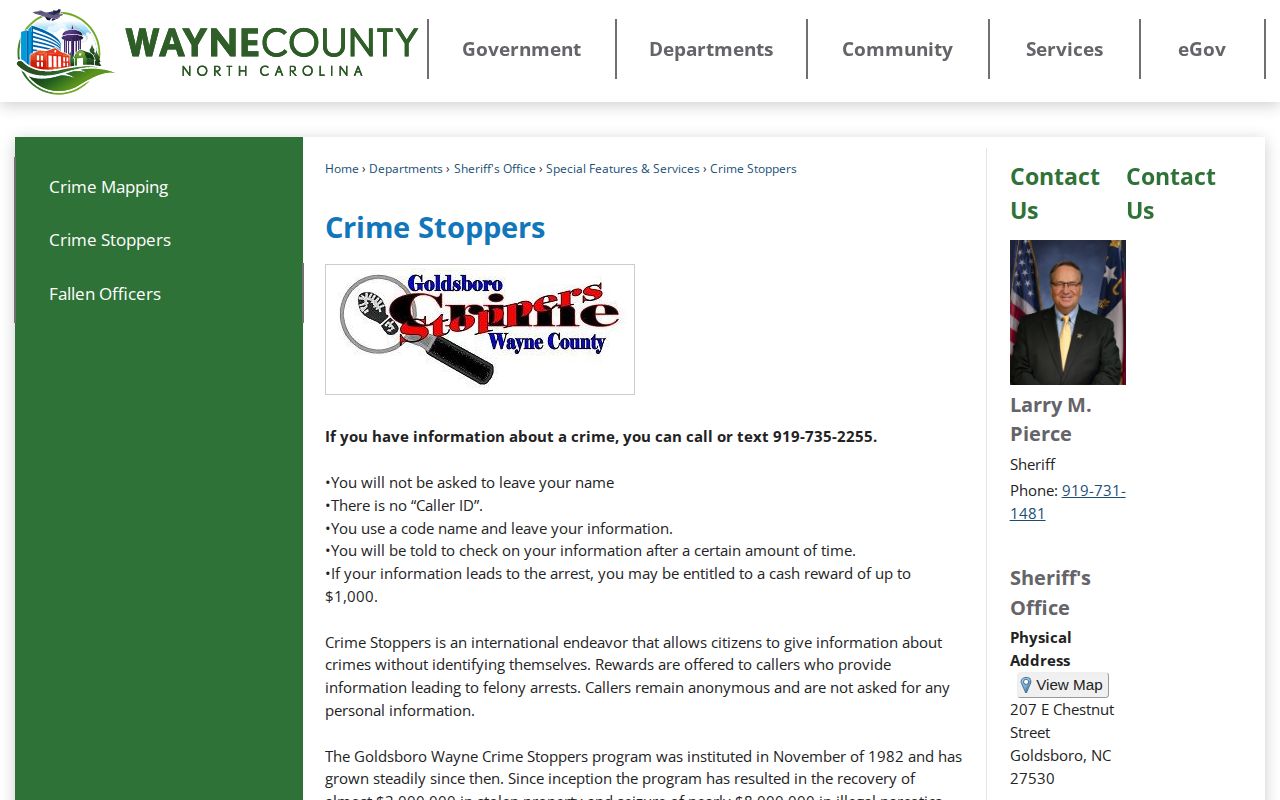
The linked page is the official tip-program source, not a wanted list and not an individual booking photograph.
Most Wanted or Warrant Check?
A most-wanted notice is an agency's own selection for publicity. A warrant check is narrower. It asks about one person's status with the courts or law enforcement. No official public Wayne warrant search exists as a self-service database. Start by calling the Wayne County Sheriff's Office main line at 919-731-1481 and asking for the proper warrant or records route. An older Sheriffs' Association directory from 2021-2022 lists 919-731-1493 as a non-emergency number. Treat that aging entry as something to confirm rather than rely on.
State law shapes what is open. North Carolina's N.C.G.S. §132-1.4 treats certain returned arrest and search warrants, indictments, summonses, and related documents as public unless sealed. Nothing in the statute forces the Sheriff to publish every active warrant. It does not make any third-party list reliable either. Ask the office or the clerk what can be confirmed and whether a seal or other limit applies.
- Call the Sheriff using the current county contact and ask how to check the specific person safely.
- Use the Wayne County Judicial Branch and eCourts for case-side information by exact name, county, citation, or case number.
- Do not infer a clear warrant status from a stale web page, an aggregator, or a missing VINE result.
- If the person is wanted and location information is known, use Crime Stoppers. For immediate danger, call 911.
App, News, and Warrant Claims
Wayne County's official Sheriff app markets itself as a tool for tips, crime reports, and public-safety alerts. It promises no warrant roster. No stream of booking photos appears in the store listing either. The county's NewsFlash archive and Media Resources page do carry official announcements. Neither functions as a day-to-day wanted list. Local newsrooms will sometimes report a warrant or an arrest. That coverage can be useful as long as you confirm it against the Sheriff or the court before treating it as settled fact.
One more habit worth building: when a story includes a photo, leave it on the publisher's site. An agency-supplied picture is not the same thing as a current booking photograph. The Wayne County news guide maps out the local outlets. The official source still has the final word on status.
Wanted, Booked, and Released
A warrant notice and a jail booking are two different moments in one case. Someone flagged as wanted may never have entered Wayne County custody. An arrest changes that. Custody details then move through the Detention Center and NC VINE. A release changes things again, since a VINE result can shift while the court case and the booking record both stay on file. The Wayne County booking guide helps you keep those stages straight. It also explains the split among agencies. NCDAC covers prison, probation, and parole rather than county warrants. The BOP answers federal custody. ICE's locator only speaks to immigration holds. None of those systems doubles as a public most-wanted gallery.
These distinctions matter most when two people share a name. Match the full name, age, case number, and date from the official source before drawing any conclusion. Unclear status? Call the Sheriff or the clerk. Never settle the question by following someone or contacting them yourself.
Families trying to make sense of a notice should build a clean paper trail. Keep the official page, the date you checked, and any contact instructions in one place. If the person has a lawyer, pass along the case number and source instead of forwarding an unverified screenshot. Court and Sheriff staff can explain what the public page leaves out.
How Warrant Records Fit
A warrant can take several forms: an order for arrest, a returned search warrant, or another type of court paper. The record might originate in a different North Carolina county. Wayne's own Warrant Squad can still serve it. The Sheriff page describes the squad as handling warrants from all 100 counties, and occasionally from other states. That reach is far wider than any local most-wanted page could show.
North Carolina's public-arrest statute treats certain returned warrants and related court documents as public unless a judge has sealed them. Public does not mean the Sheriff must run a live database. It also does not erase the need to check whether a court record has since changed. Anyone with a question about their own status should call the Sheriff and ask for the safe records route. A third-party list will never substitute for that answer.
- Use the current Sheriff page to identify the agency and warrant channel.
- Use Wayne County eCourts to look for case-side information and scheduled events.
- Use NC VINE only for the custody and notification question it is designed to answer.
- Use Crime Stoppers for information about a wanted person, never for a confrontation.
Keeping these records separate also guards against a false match. Similar names, revised charges, sealed files, and dated photographs can all push an online notice the wrong way. Write down the source date. Ask the originating office to confirm the detail that matters. When a public page gives no clear answer, that uncertainty is your cue to stop and verify. Do not patch the gap with a copied image or a guessed status. The narrow answer from the office that owns the warrant is always the safest record.